Posts

Showing posts with the label protection

TRANSFORMER COMMISSIONING

Image
Insulation Resistance All know that the resistance of a pure insulation is infinity. But to no extend we can make a pure insulation. So we have a small leakage current to flow through insulation depending upon the voltage applied. Thus as the result we get a resistance value in the range of Mega Ohms(MΩ) or Giga Ohms(GΩ).   Here the applied voltage is DC. We have separate kit for injecting the DC voltage. Usually that equipment is known as megger. The two windings are connected as in the diagram above and Megger is used to measure the insulation resistance. It applies a high voltage normally 500V or 1kV for time period of minimum 30 seconds to One minute and the respective resistance are noted down. Usually for a new transformer, result value will be in Giga Ohms(GΩ). During the ageing, deposition of dust, moisture and other unwanted particles can cause the megger value to reduce. So to gain the resistance back to normal, the dust deposited should be removed, moisture shoul...
Differential Protection Scheme (Transformer)

Image
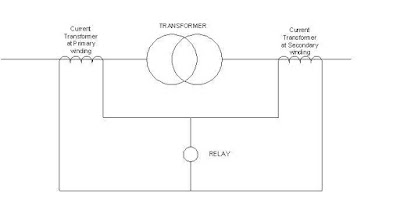
Hey friends! you are familiar with the power system equipment which we discussed earlier.! Now it's time to protect it to total safety. As soldiers protect our country from enemies likewise our system should be protected from fault. The line of control is decided by fixing the current transformers on the right place. So our boundaries is decided by their location. Here in a substation, we have many equipments such as transmission lines, bus-bar, transformers, etc in the system which need atmost care. Starting from the bulkiest, transformers are having different level of protections such as phase to phase and phase to ground. In other words differential protection and earth-fault protection. Over-current protection is also implemented in it. Let's talk about the differential type of protection for transformers. It's quite simple to explain the theory but some complicated while coming into the calculation. The term itself gives a brief idea about the ...

Lightning Arrester

Image
  Lightning.....! the wicked thing in our power system.                     For us it creates only damages. So is important to protect the crores worth devices which support the generation, transmission and distribution of power. Starting from the generating stations, all the power cables are connected to a device which is called surge diverter or lightning arrester. In transmission towers we draw a separate line for earth at the top of the tower. By that line we create a zero potential at the top of tower. Thus protecting transmission lines from lightning surges. Electrical surge produces a large transient over voltage in the electrical network and system. The shape of the transient over voltage has a steeply rising front with slowly decaying tail. There are two types of surges one comes externally from atmosphere such as atmospheric lightning. Second type is originated from electrical system itself, such as swi...

Current Transformers

Image
  Did we want to really concerned about the current transformers ? Its just an instrument transformer Yeah!,  that's make it different in protective relaying Lets dig deep                             In the most protective relays the input quantity is current and these current are supplied by current transformers. located on or near to the protected equipment. The main functions of CT are 1. To isolate the power system circuit from protection circuit 2.Reduction of magnitude to a level accessed by relays and meters  When considering Constructional features, these are similar to normal transformers consisting a magnetically coupled primary and secondary windings, wound on a common iron core and the primary is connected in series with  the network and the ratio could be found from basics ie,   Ampere-turns in primary=Ampere-turns in secondary ie, low no. of t...

A Glance at protective devices

Image
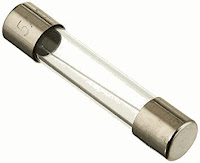
A protective device is an equipment that can protect machinery,components and man in operation. Or in electrical aspects, a protective device can act against short circuit, over current and such abnormalities in a system.           There are many types of protective devices employed in the modern era though a major part includes the former. The main types among them are: 1) Fuses 2) Circuit breaker 3) Relays 4) Earthing devices FUSE: A fuse is a small crosection conducting path or wire and it is enclosed by a insulating non combustible cartridge. It allows only a rated value of current passing through it say the 'rated amps" And also it sacrifices it's life when an increased or abnormal current flows through it.! Principle of operation of a fuse is obviously the melting of wire when it us heated Up while caring more than rated value in prior to eqn i2rt. And there by breaks the circuit. A main drawback of a c...

Safety and Protection

Image
Are you excited about Electricity ? You may have to know much about the enormous behavior of  current. No, it wont bite you unless you are not cared about it.      Here we bring some safety and protection aspects in electrical power handling. As we know the current is the flow of charges, which exists if and only if  there is potential difference and a closed loop(otherwise ideally we could say infinite resistance in the path, resulting in zero current).    When we are focusing on our safety its better to consider the after effects as there is a potential and closed path, when we make some contacts.It's all that matters is the threat of electrical shock . It depends on the power level of the source, that it could circulate a certain amount of charge per second through your body. The different current levels and effects are as follows  1mA - some threshold of sensation 10mA - effect may vary from Mild sensation to painful shock ...